Senior product designer bridging human impact and technical complexity. Builds enterprise platforms, consumer products, and campaigns at companies like Etsy and Uber.
Some recent work: Logistics Platform / Redesigned Payments / Video Adoption / AI-Powered Validation
Ghost
Zero-to-one logistics platform at enterprise scale
Ghost is a private distribution platform for the world’s best brands. Operations teams support millions in monthly volume but spent 4-6 hours daily managing freight across 5+ disconnected tools.
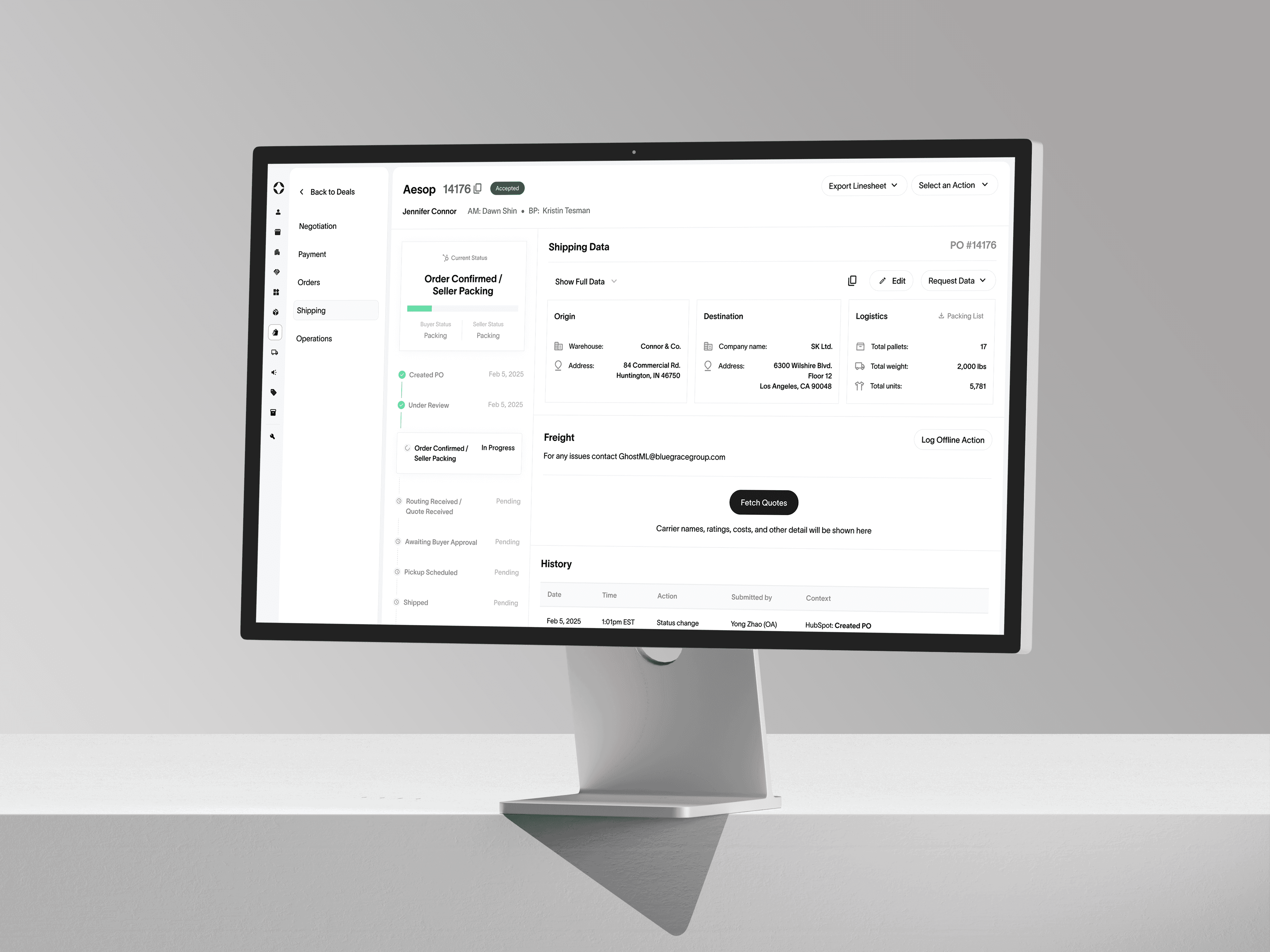
^ New comprehensive, consolidated tooling
My Role
End-to-end strategy and design
Alignment across 8 roles
Balance of competing constraints
Impact
Unified freight platform (nine-figure AOV)
75% reduction in manual work
Replacement of third party tools
Business Challenge
Operations relied on disconnected tools, a strategic gap impacting audit trails and ship times. Leadership tasked me with designing a zero-to-one freight product, consolidating workflows.
^ Workflow chaos (from quotes to buyer/seller communications to booking)
Breaking Down the Problem
The ultimate challenge wasn't building a freight tool but navigating technical and organizational constraints. I needed to integrate with existing systems, our shipping providers API requirements didn't map to our data models, and our 8 user roles had opposing needs.
^ Early explorations
Architecturally, I was designing for two distinct experiences: feature-rich admin dashboard and a simplified buyer flow.
Impact
My unified platform yielded:
75% reduction in manual work
Support for multi-millions of monthly order value
Built-in document compliance for each order’s significant paper trail
Automated financial reporting and reconciliation
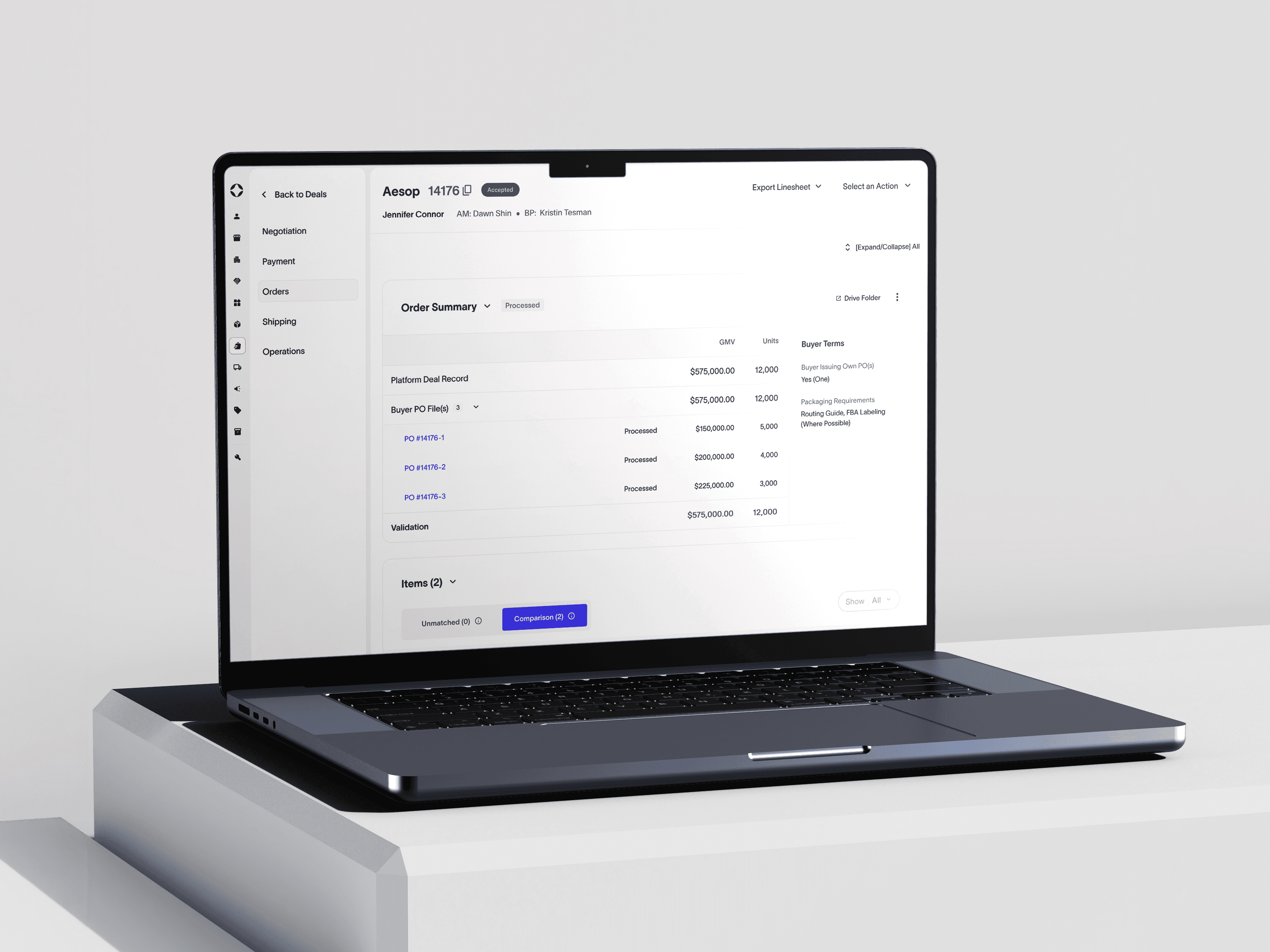
^ Internal and externai touchpoints
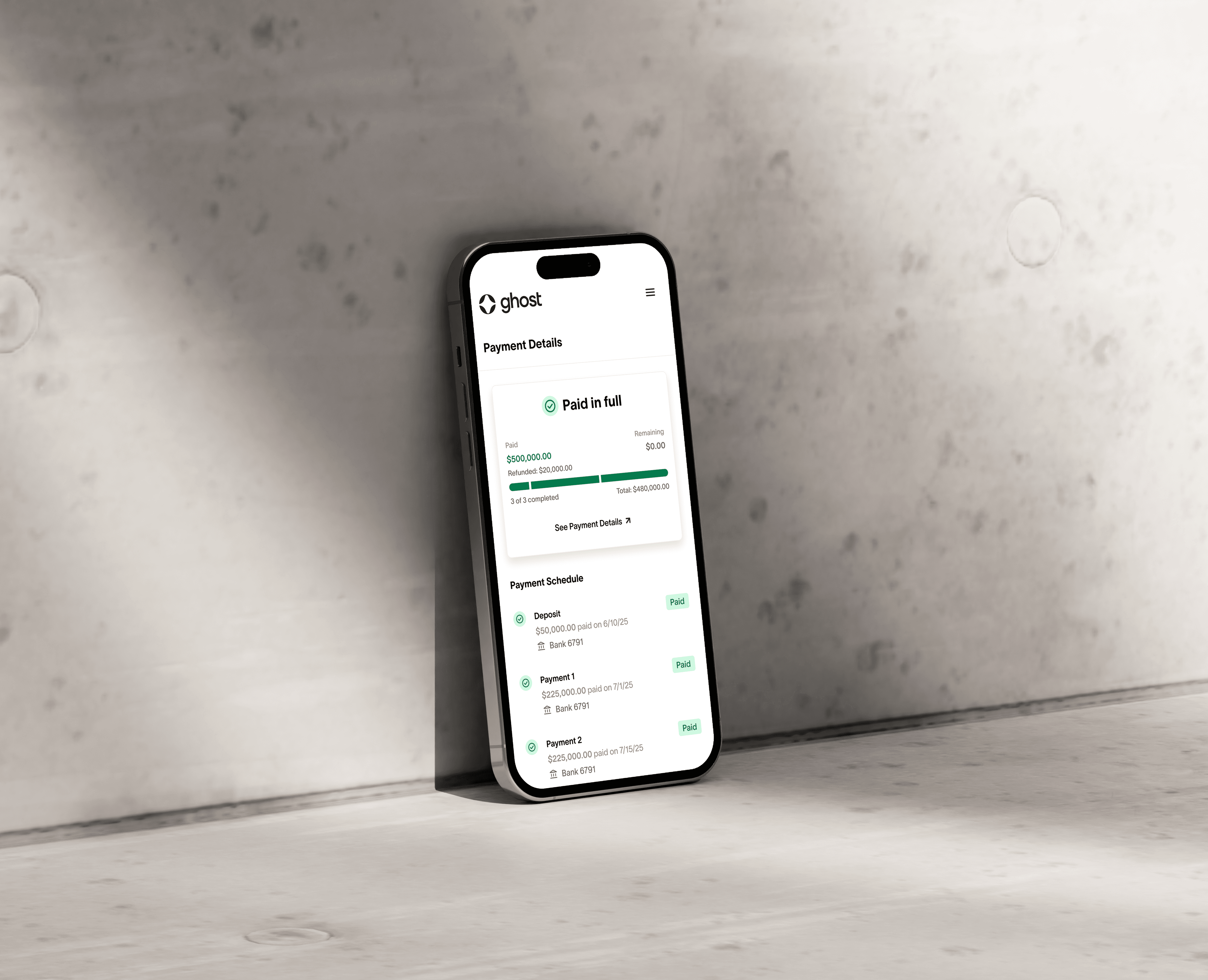
^ Mobile buyer experience
Looking Back
Given the mass scope I’d leverage rapid prototyping earlier to de-risk faster
Constraints drove better design
Operations leadership and I also ideated leveraging our internal AI-powered assistant for historical freight insights and real-time tracking.
^ Future idea for real-time insights via AI-powered chat
Ghost
Payment flexibility for hundreds of merchants
Ghost’s B2B payment functionality was narrow with low adoption. Significant manual involvement was required to support multi-millions in weekly order values.
^ Expanded functionality in redesigned payments product
My Role
Led end-to-end research and design
Aligned leadership across 3 organizations
Designed flexibility and operational control
Impact
24% adoption to 96%
1,000 monthly hours saved (=6 FTE)
Zero failures across $47M in transactions
Streamlined infrastructure and workflow
Shortened deal lifecycle
^ Extremely limited capabilities in legacy product
Business Challenge
Our rigid system couldn't serve clients (single-person shops to Fortune 500 companies) threatening retention and competitive advantage.
Finance manually reconciled 76% of payments across three systems, and 40% of orders were delayed awaiting payment.
Breaking Down the Problem
Auditing 150 deals revealed operational chaos: Numerous use cases, API rate limits, 40+ handoffs per deal. 78% of deals required fully custom terms, and our stakeholders had competing needs.
^ Numerous payment scenarios to support / Workflow discovery
^ Comprehensive fulfillment blueprint
Approach & Solution
I embedded with Operations and Finance, mapping out their intensive workflows. My PM, eng leads, and I targeted payment opportunities across dual tracks:
Product: Event-based triggers, installment flexibility (10+), multiple payment methods
Operations: Deal acceptance payment terms, templatized term options, Finance approval gates
^ Flexible payment plans
Impact
Within 3 weeks of launch we saw:
A 57% reduction in operational toil (35hrs → 15hrs/deal)
Zero failures across $47M in payments
Usage rise to 96%, and event-based triggers influenced milestone tracking
^ Refined buyer experience
Looking Back
Engineering partnership was critical for navigating constraints
Influencing operational efficiency can be just as impactful as UI refinement
Etsy
$1.1M+ quarterly GMS through video adoption
Etsy sellers were missing out on 2x in sales by not using listing videos.
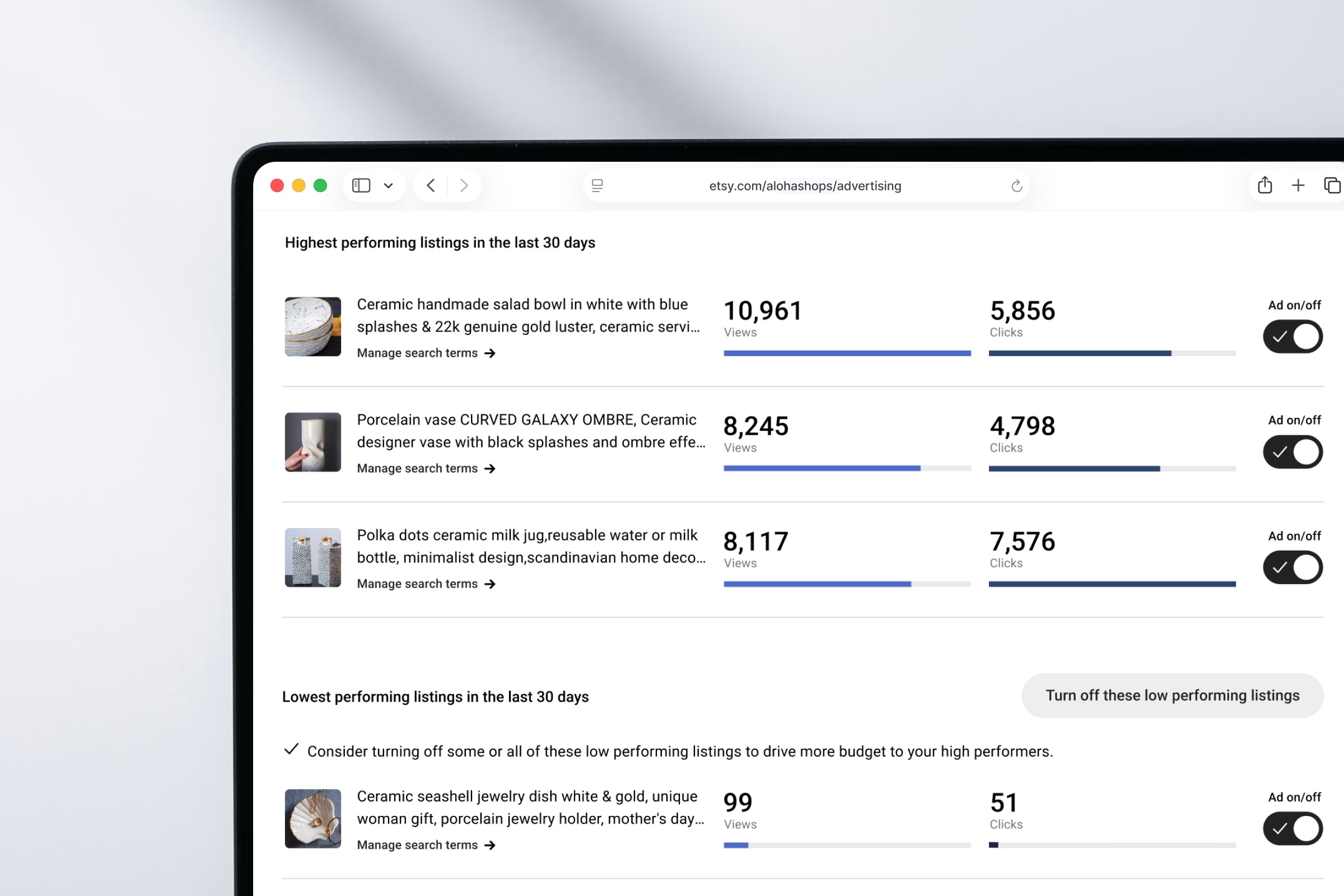
^ Listing videos drive sales on Etsy
My Role
Led design across three seller teams
Facilitated 24-person strategic Discovery
Aligned cross-functional leadership
Designed evolving A/B experiments
Impact
Drove $1.1M+ quarterly GMS
Established experimentation framework
Shaped roadmap across 5 strategic themes
^ Phased experimentation approach / Competitive audit for Discovery workshop
Business Challenge
Despite a video significantly increasing GMS only 15% of active listings included one. We discovered sellers didn't believe videos were worth the time.
Breaking Down the Problem
I built a phased experiment strategy, orchestrated across three teams with competing priorities. Each experiment integrated learnings, and design-led discussions kept partner teams aligned throughout.
Dual Track Approach
In parallel, I executed Discovery workshops with 24 stakeholders to learn more and inform our roadmap.
^ Brainstorm output
Impact
The experiments drove $1.1M+ in GMS in one quarter and continued increasing video coverage. Workshops generated a roadmap of 40+ features across five themes that powered our next quarters of work.
Looking Back
Phased experimentation built stakeholder buy-in through early wins
Dual paths drove velocity
^ Mobile experiment
Ghost
AI-powered validation in hours, not weeks
Rapid prototyping leveraging AI tools evolved how my team at Ghost validated internal explorations.
My Role
Built AI-powered prototypes
Refined with PM/eng and partners
Aligned across leadership
Impact
Assumptions tested in real-time
Roadmap informed by feedback
Higher confidence in quality
^ Using Lovable to test into logic
The Challenge
Our team’s domain was exceptionally broad and deeply technical. We needed a way to shorten feedback loops and rescope with confidence.
Approach 1 (Lovable & Claude)
Collecting deal terms involved complex, conditional shipping data. I created an interactive prototype with foundational logic that could be modified based on stakeholder feedback.
^ Shipping questionnaire prototype
Approach 2 (TableFlow partnership)
Partnered with third party to create custom integration for order splitting and reconciliation. It automated a highly manual process, and informed how our platform should be shaped.
^ Order splitting and reconciliation automation
Approach 3 (Cursor & pairing)
The lead engineer vibe coded a shipping calculator while we paired on data modeling, enabling faster design refinements and accelerating partner delivery.
Looking Back
This builds on my Etsy work running a 400-seller prototype group testing 14 features.
Invalidate early to reduce waste
Tangible experiences can be more influential than polished concepts
^ On-platform freight calculator